Microneedle Patch vs. Eye Cream: Where Each One Reaches
Eye creams and dissolving microneedle patches are not the same delivery method. We compare them on mechanism — not marketing — to explain the difference.
Microneedle Patch vs. Eye Cream: Where Each One Reaches
Eye creams and dissolving microneedle eye patches are often mentioned in the same breath, as if they were interchangeable steps in a routine. They are not the same thing, because they do not deliver the same way. Comparing them on mechanism — rather than on marketing — makes the difference clear.
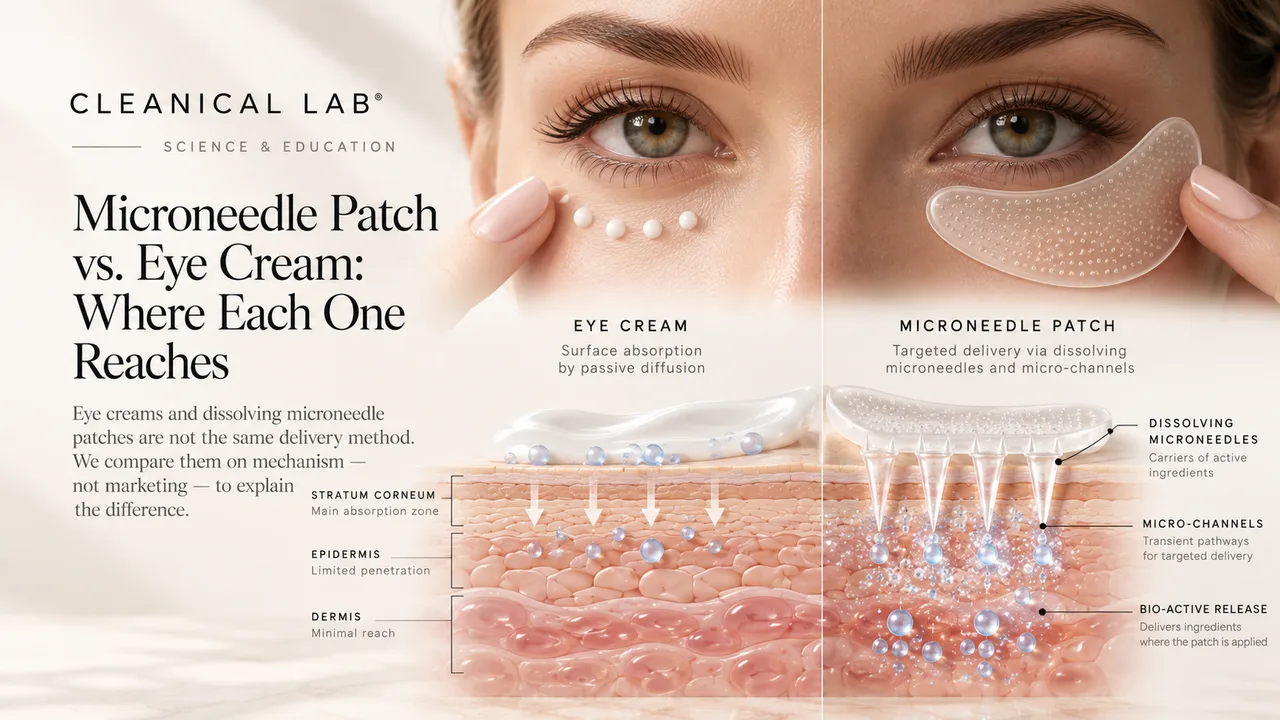
Two delivery methods, not two versions of one product
- An eye cream is a leave-on topical. You apply it to the skin surface, and its ingredients are absorbed across the upper layers by passive diffusion.
- A dissolving microneedle patch carries its formulation within dissolving microneedles. Applied with firm, vertical pressure, the microneedles engage the skin and dissolve, creating transient micro-channels through which the bio-active formulation is released where the patch is applied.
The distinction is delivery: surface absorption versus a targeted micro-channel route. For the underlying science, see how dissolving microneedles work.
What each one is built to do
An eye cream is a flexible, everyday hydration and skincare step. It is applied consistently, spread over a wide area of skin, and works by supporting the skin surface.
A microneedle patch is a defined, protocol-driven treatment. It is applied to specific target zones, worn for 2 to 4 hours (overnight is even better), and used on a schedule — one application every 72 hours, for 5 applications. It is single-use.
One is a daily surface step; the other is a finite, targeted course. That difference in use pattern matters as much as the difference in delivery.
Where the patch is placed
The Salmon PDRN Microneedle Patch System targets the key wrinkle zones — the forehead, crow's feet and nasolabial folds — with each patch positioned over the area of concern and pressed firmly into contact.
Because a patch is placed precisely, it delivers its formulation to the zone it covers, rather than spreading across the whole face. That precision is the point. For placement technique, see where to apply microneedle patches.
They are not mutually exclusive
Nothing about this comparison suggests you should stop using an eye cream. The two work on different terms and at different times:
- Your daily cream supports the skin surface as part of an everyday routine.
- Your patch course is a periodic, targeted 5-application protocol.
If you use both, keep the timing clean: apply patches to clean, dry, bare skin, and complete your routine after removal. Avoid applying serums or oils to the target area immediately before a patch, as residual product can compromise the dissolving microneedle matrix and patch adhesion.
For how patches compare with hydrogel — the other common patch format — see microneedle vs hydrogel patches.
A patch is not a "stronger cream"
It is tempting to think of the patch as an eye cream turned up a level — a more potent version of the same thing. It is not. A cream's job is surface support, applied broadly and often; a patch's job is targeted delivery of its formulation to specific zones on a defined schedule. The formats are built for different roles, and neither is simply "more" than the other.
What about layering under and over the patch?
The dissolving microneedle matrix needs bare, clean, dry skin to engage properly. That drives three practical rules:
- Before: apply to clean, dry skin — no serum or oil directly under the patch.
- During: do not lay products over the patch while it is worn.
- After: once you remove and discard the patch, complete the rest of your routine.
These rules apply whether or not you also use a cream; they are about giving the patch a clean surface to work with.
A note on claims
The system is a cosmetic product for external use. The packaging states visible improvement in 4 weeks — when used as part of the full 5-application protocol; results may vary by individual. Neither a cream nor a patch is a medical treatment, and neither is intended to diagnose, treat, cure or prevent any disease.
Frequently asked questions
Is a microneedle patch just a fancier eye cream?
No. An eye cream is a leave-on surface topical. A microneedle patch delivers its formulation through dissolving microneedles and transient micro-channels, applied to specific zones on a defined schedule.
Can I use both?
Yes. Use the patch on clean, dry, bare skin, and apply other products after removal. The patch course is a periodic protocol; a cream is a daily step.
Which is better?
They are built for different roles. The honest comparison is delivery method and use pattern, not a claim that one replaces the other.
How often is the patch used?
One application every 72 hours, for 5 applications.
How long is each patch worn?
2 to 4 hours; overnight is even better.
Where does the patch go?
On the key wrinkle zones — the forehead, crow's feet and nasolabial folds — each patch over the area of concern.
Commitment, routine and cost
The two formats ask for different things, and it helps to see that plainly:
- An eye cream asks for consistency. It is a daily step, used broadly, and its value comes from repetition.
- A microneedle patch asks for a finite commitment. It is five applications over four weeks, each worn for 2 to 4 hours, each single-use.
Neither approach is "better" in the abstract — they are different kinds of commitment. If you want a daily surface step, a cream fits. If you want a defined, targeted course with a start and an end, the patch fits.
Can a cream do what a patch does?
The honest answer is that they are built for different jobs, so the question is slightly mis-framed. A cream's job is surface support across a wide area, applied often. A patch's job is to carry its formulation within dissolving microneedles and release it through transient micro-channels at the specific zones it covers. Where a cream spreads, a patch targets; where a cream is daily, a patch is scheduled. The delivery method — not just the ingredient list — decides what each can do.
What "mechanism-first" means here
It is easy to compare two products by their labels, their prices or their promises. The more useful comparison is by mechanism: how does each one actually deliver what it carries? For a cream, the answer is passive diffusion across the skin surface. For the patch, the answer is dissolving microneedles and transient micro-channels at the point of application. Comparing on mechanism keeps the conversation grounded in what each format physically does, rather than in adjectives. That is the same lens we use to compare microneedle with hydrogel patches.
Choosing between them in practice
In practice most people do not choose one or the other — they use both, at different times:
1. Daily: your eye cream or serum as the surface step of your routine.
2. Periodically: your 5-application patch course, applied on clean, bare, dry skin at the 72-hour interval.
3. Sequenced: complete the patch application first, then finish with the rest of your routine after removal.
The rule that keeps both working is simple: give the patch a clean surface, and complete everything else around it.
A note on what results mean
Both a cream and a patch are cosmetic products for external use. The packaging for the patch states visible improvement in 4 weeks — when used as part of the full 5-application protocol; results may vary by individual. Neither format is a medical treatment, and neither should be expected to act like one. Reading each product's own instructions is the most reliable guide to what it is designed to do.
The one-line summary
If you remember nothing else from this comparison: a cream supports the surface, a patch targets a zone. Different delivery, different use pattern, different job. That is the whole distinction, without the adjectives.
Where each one fits your routine
Thinking in terms of routine slots keeps the two from competing:
- Morning or evening surface step: an eye cream or serum, applied broadly and consistently.
- Periodic targeted course: the 5-application patch protocol, applied to specific zones on clean, bare skin.
- Sequence: patch first, routine after — never the other way around on a patch day.
Laid out this way, there is no conflict to resolve. The cream does its daily job; the patch does its scheduled one.
The takeaway
An eye cream and a dissolving microneedle patch are two different delivery methods with two different use patterns: a daily surface step versus a finite, targeted course. Understanding that difference is more useful than comparing them as if they were the same product.
For the formulation behind the patch, see the ingredient transparency page; for the full protocol, start with how dissolving microneedles work.
---
Cleanical Lab patches are designed for cosmetic use and are not intended to diagnose, treat, cure, or prevent any medical condition. If you have a known skin condition, are pregnant, or are under dermatological care, consult your physician before beginning any new skincare protocol.
Follow the Protocol
A defined course: five applications, every 72 hours, with the Salmon PDRN bio-active formulation in dissolving microneedles. The packaging states visible improvement in 4 weeks.*
Explore the Protocol →Related Research
How Dissolving Microneedles Work: The Science Behind Targeted Delivery
A science deep dive into dissolving microneedle technology — how microneedles create transient micro-channels through the skin barrier to deliver their bio-active formulation where it is applied.
Science & EducationMicroneedle Patches vs. Hydrogel Patches: A Mechanism-First Comparison
Hydrogel patches deliver surface hydration. Dissolving microneedle patches deliver their formulation past the barrier. We compare both technologies on mechanism, not marketing.