How Dissolving Microneedles Work: The Science Behind Targeted Delivery
A science deep dive into dissolving microneedle technology — how microneedles create transient micro-channels through the skin barrier to deliver their bio-active formulation where it is applied.
How Dissolving Microneedles Work: The Science Behind Targeted Delivery
For decades, the single greatest obstacle in topical skincare has been the stratum corneum — the outermost layer of the epidermis, a formidable barrier of corneocytes embedded in a lipid matrix that rejects the vast majority of applied molecules before they ever reach living tissue. Creams, serums, and gels are engineered around this problem, but the fundamental physics remain unchanged: many desirable molecules — including large, hydrophilic ones — have a passive penetration rate so low that only a negligible fraction ever crosses the barrier.
Dissolving microneedle technology exists to address this problem at its root. Rather than formulating around the stratum corneum, it creates microscopic pathways through it — then releases the formulation where a surface-applied product largely cannot reach.
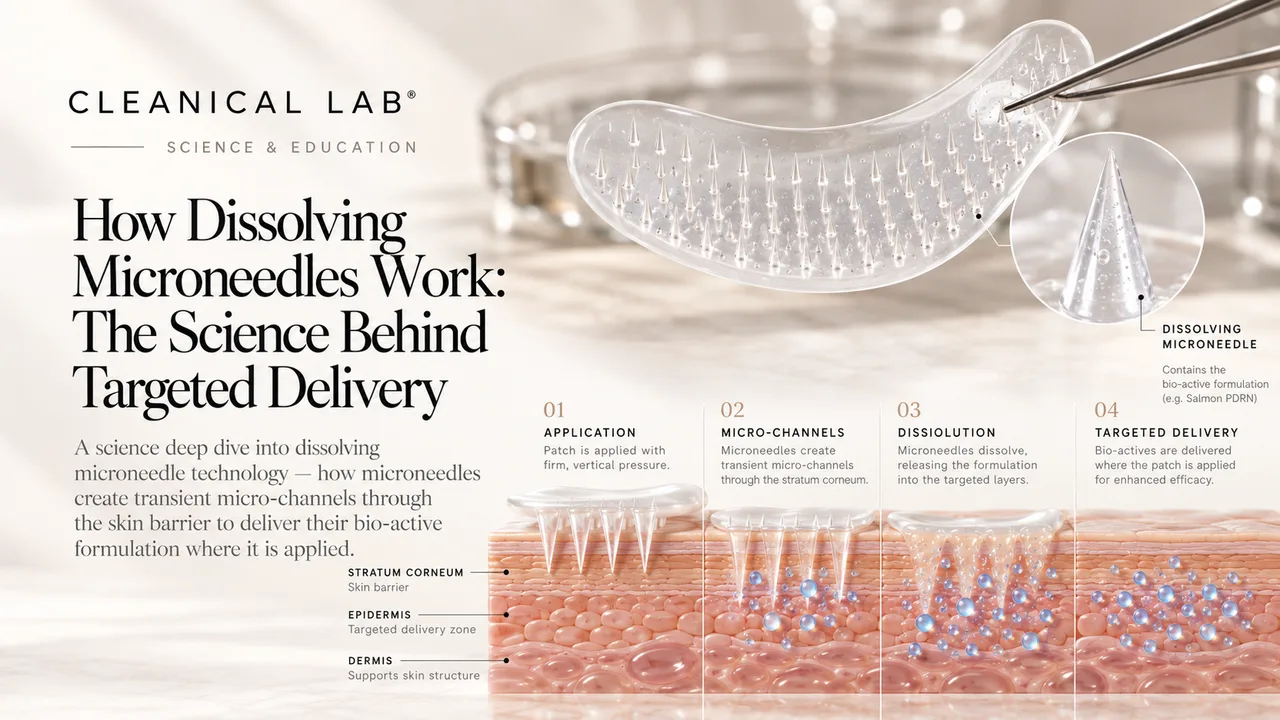
This article walks through the mechanism, the dissolution process, and the design rationale behind the technology used in the Cleanical Lab Salmon PDRN Microneedle Patch System.
What Are Dissolving Microneedles?
Definition and Mechanism Class
Dissolving microneedles are a subclass of microneedle delivery systems in which the microstructures themselves are fabricated from water-soluble materials and dissolve after application. Unlike solid microneedles — which puncture the skin and are then removed before a separate formulation is applied — or hollow microneedles — which inject a liquid through a bore — dissolving microneedles carry the formulation within the microstructure itself. Upon contact with skin moisture, the needles dissolve, releasing the formulation they carry.
This design has three immediate advantages:
1. No residual sharps waste. The microstructures dissolve; nothing solid remains to retrieve or dispose of.
2. Single-step delivery. Application and release occur in one step.
3. Protocol precision. Each patch is a defined unit — one sachet equals one application — which makes the treatment course simple to follow.
The Bio-Active Formulation
In the Cleanical Lab patch system, the formulation carried by the dissolving microneedles is built around Salmon PDRN (Polydeoxyribonucleotide). The patch acts as the delivery platform: the microneedles engage the skin with firm, vertical pressure, dissolve upon contact with skin moisture, and release the bio-active formulation they carry. The complete ingredient composition is printed on the product packaging.
Transdermal Delivery: Bypassing the Stratum Corneum
The Barrier Problem
The stratum corneum is approximately 10–20 microns thick and consists of 15–20 layers of flattened, keratinized corneocytes surrounded by a lamellar lipid bilayer. Its function is selective exclusion — it keeps water in and keeps foreign molecules out. For large or hydrophilic molecules, passive penetration through an intact stratum corneum is essentially zero.
This is why many topical products function primarily as surface treatments. They sit on the stratum corneum, work at the surface, and are eventually washed off or shed with desquamation. They do not reach the viable epidermis in any meaningful quantity.
The Microneedle Solution
Dissolving microneedles cross the stratum corneum mechanically. Each microstructure creates a transient micro-channel as it dissolves, passing through the barrier layer and into the viable epidermis beneath. Because the formulation is carried within the microstructure itself, it is released at depth — there is no reliance on diffusion through the barrier, because the barrier has been physically traversed.
The Dissolution Process
Step-by-Step Mechanism
When a patch is applied, the following sequence occurs:
1. Application (seconds). The patch is positioned over the target area and firm, vertical pressure is applied for about 15 seconds to engage the microstructures with the skin surface.
2. Fluid contact (minutes). Skin moisture contacts the microstructures. The water-soluble material begins to hydrate.
3. Matrix dissolution (hours). The microstructures gradually dissolve, releasing the Salmon PDRN bio-active formulation they carry into the micro-channels they created. This is why patches are left in place for 2 to 4 hours — or ideally overnight.
4. Backing removal. After the wear period, the backing is removed. The microstructures are designed to dissolve as the formulation is released, leaving no solid residual material.
Why This Beats Passive Diffusion
The key insight is that dissolution in place means the formulation is released at depth, not at the surface. There is no concentration gradient fighting against the stratum corneum. The molecule does not need to be small or lipophilic or paired with penetration enhancers — it is carried mechanically past the barrier by the dissolving microstructure itself.
Dissolving Microneedles vs. Passive Topicals
| Factor | Passive Topical (cream/serum) | Dissolving Microneedle Patch |
|---|---|---|
| Stratum corneum | Unpenetrated — barrier intact | Traversed — transient micro-channels created |
| Release location | Skin surface | At depth, as the microstructure dissolves |
| Delivery profile | Passive diffusion only | Mechanical placement + in-situ dissolution |
| Dose consistency | Variable — depends on application amount and spread | Defined — one patch equals one application |
| Duration of effect | Short — surface product washes or sheds away | Sustained wear period (2–4 hours or overnight) |
The takeaway is straightforward: for formulations whose molecules cross intact skin poorly, passive topical delivery is limited to surface effects. Dissolving microneedles are not an incremental improvement over creams — they represent a categorically different delivery route, one that places the formulation where a surface product cannot reach.
Evidence and Ongoing Research
The field of dissolving microneedle delivery has accumulated substantial peer-reviewed evidence over the past two decades, spanning vaccine delivery, insulin delivery, and cosmetic active delivery. Studies consistently demonstrate that dissolving polymeric microneedles can deliver macromolecular actives far more effectively than passive topical application.
For how we apply this technology — the 5-application protocol at 72-hour intervals and the packaging-stated visible improvement in 4 weeks* — see our clinical foundations page.
Cleanical Lab continues to study the delivery platform behind the Salmon PDRN Microneedle Patch System, with the goal of further optimizing application guidance and protocol design.
---
Frequently Asked Questions
How is a dissolving microneedle different from a solid microneedle roller (dermaroller)?
A dermaroller uses solid metal needles to create channels in the skin, then a separate topical product is applied afterward in hopes that some of it enters through the channels. A dissolving microneedle carries the formulation within the microstructure itself — when it dissolves, the formulation is released in place. There is no separate application step, no reusable needle head, and no solid sharps to clean up.
Can dissolving microneedles damage the skin?
The microstructures are designed for cosmetic at-home use. They engage the upper layers of the skin, dissolve as the formulation is released, and leave no solid residual material. The micro-channels they create are transient and reseal as the tissue rehydrates. Apply to intact, cleansed skin, follow the 72-hour interval between applications, and review the enclosed leaflet and our clinical disclaimer before use. Discontinue use if irritation occurs.
Why is the formulation carried inside the needle?
Embedding the Salmon PDRN bio-active formulation within the microstructure means application and release are a single step: the microneedles dissolve in contact with skin moisture and release the formulation at depth, rather than leaving it on the surface. This is what makes the patch a targeted delivery system rather than a surface treatment.
Follow the Protocol
A defined course: five applications, every 72 hours, with the Salmon PDRN bio-active formulation in dissolving microneedles. The packaging states visible improvement in 4 weeks.*
Explore the Protocol →Related Research
Microneedle Patches vs. Hydrogel Patches: A Mechanism-First Comparison
Hydrogel patches deliver surface hydration. Dissolving microneedle patches deliver their formulation past the barrier. We compare both technologies on mechanism, not marketing.
Science & EducationHow Often to Use Microneedle Eye Patches: The 72-Hour Rule
Microneedle eye patches work on a schedule, not a whim. Here is why the 72-hour interval is built in — and how the 5-application course fits together.