Microneedle Patches vs. Hydrogel Patches: A Mechanism-First Comparison
Hydrogel patches deliver surface hydration. Dissolving microneedle patches deliver their formulation past the barrier. We compare both technologies on mechanism, not marketing.
Microneedle Patches vs. Hydrogel Patches: A Mechanism-First Comparison
The topical patch category has expanded rapidly over the past decade. Two technologies dominate the shelf: hydrogel patches and microneedle patches. On the surface they look similar—both are adhesive, both promise "active delivery," both are marketed for under-eye and targeted concerns. But their mechanisms, penetration profiles, and clinical utility diverge sharply.
This article compares the two patch technologies across five parameters that matter to formulators, clinicians, and informed consumers: delivery mechanism, penetration depth, ingredient compatibility, results timeline, and cost per application. The goal is not to dismiss hydrogel patches—they serve a legitimate role in surface hydration—but to clarify where each technology sits on the delivery spectrum so that product choices rest on mechanism rather than marketing language.
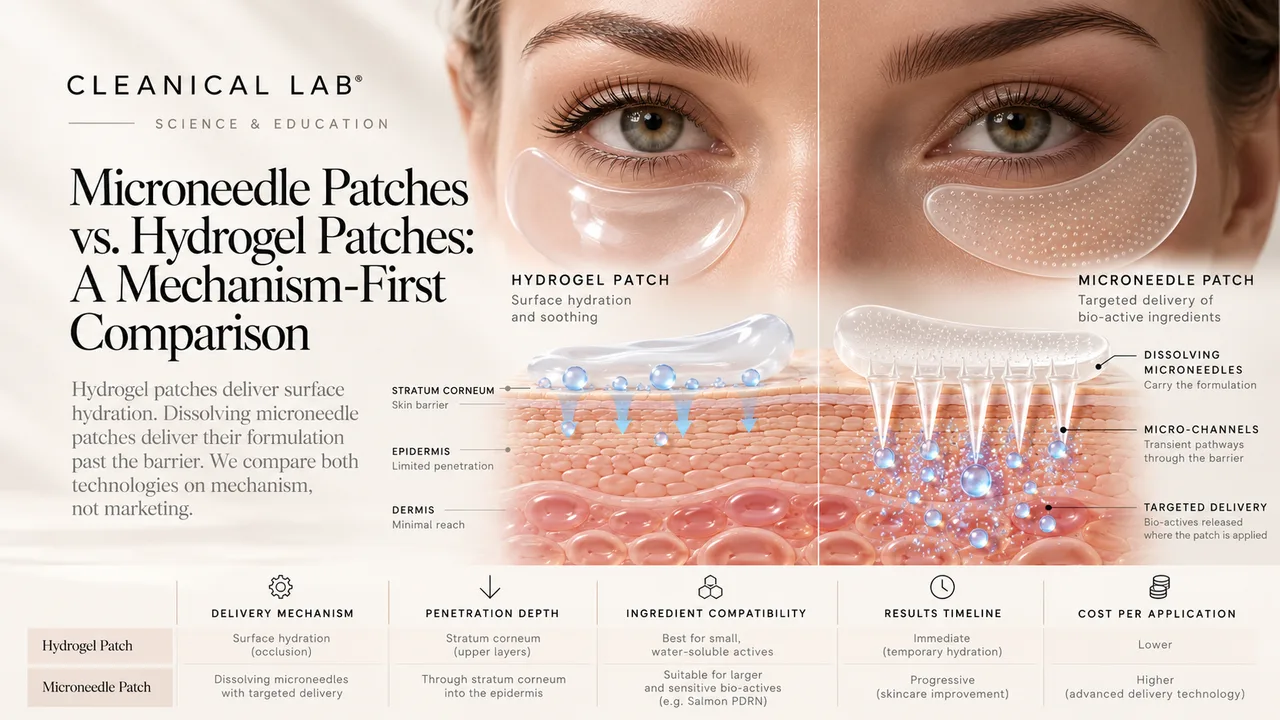
---
1. Delivery Mechanism
Hydrogel Patches
Hydrogel patches are water-rich polymer matrices—typically composed of cross-linked polymers such as sodium polyacrylate, carboxymethyl cellulose, or agar-based gels—suspended in a glycerin or hyaluronic acid serum. The patch adheres to the skin surface and relies on passive diffusion: water-soluble actives migrate from the hydrogel into the stratum corneum (the outermost skin layer) down a concentration gradient.
No mechanical breach of the skin barrier occurs. Delivery is governed by Fick's law of diffusion, which means the rate and depth of active transport are limited by the molecule's size, lipophilicity, and the integrity of the stratum corneum. Hydrogels also function as occlusive dressings: by trapping transepidermal water loss, they increase skin surface hydration, which transiently softens the stratum corneum and modestly improves diffusion of hydrophilic ingredients.
Microneedle Patches
Microneedle patches use arrays of micro-scale structures—typically 0.3–1.5 mm in height and 50–250 µm at the base—fabricated from dissolving polymers such as hyaluronic acid, polyvinylpyrrolidone (PVP), or carboxymethyl cellulose. The microneedles are loaded with bio-active ingredients during fabrication.
On application, the microneedles mechanically breach the stratum corneum and enter the viable epidermis (and, depending on needle length, the upper dermis). The polymer matrix then dissolves in interstitial fluid, releasing the encapsulated actives directly into the tissue below the barrier. This is a fundamentally different delivery route: it bypasses the stratum corneum rather than relying on diffusion through it.
Dissolving microneedle arrays are the most clinically relevant subtype for cosmetic and dermatologic use because they leave no sharps waste, are self-administered, and have a favorable safety profile relative to hollow or solid metal microneedles.
For a deeper look at the technology behind dissolving microneedle delivery, see our technology overview.
---
2. Penetration Depth
Penetration depth is the single most consequential difference between these two technologies, because it determines which skin layers receive the active and, therefore, what kinds of concerns the patch can meaningfully address.
| Parameter | Hydrogel Patches | Microneedle Patches |
|---|---|---|
| Delivery mechanism | Passive diffusion; occlusive hydration | Mechanical micro-penetration + polymer dissolution |
| Penetration depth | Stratum corneum only (~10–20 µm) | Viable epidermis to upper dermis (~300–1,500 µm) |
| Ingredient types | Hydrophilic, low-molecular-weight (HA, glycerin, niacinamide, peptides ≤ 500 Da under favorable conditions) | Broad: peptides, growth factors, vitamins, botanical extracts; size less limiting |
| Onset of results | Immediate surface hydration; transient plumping | Hours to days for actives to take effect; cumulative over weeks |
| Duration of effect | Hours (hydrating effect fades after patch removal) | Days to weeks (actives deposited intradermally continue working) |
| Cost per application | $2–$8 (single-use; frequent reapplication needed) | $8–$25 (single-use; less frequent application needed) |
| Primary clinical role | Surface hydration, soothing, transient cosmetic plumping | Targeted delivery of bio-actives for structural and functional skin concerns |
The stratum corneum is approximately 10–20 µm thick and functions as the skin's primary barrier. Hydrogel patches deliver into this layer and, at most, into the upper reaches of the viable epidermis under occlusive conditions. Many actives of interest—certain peptides, growth factors, and larger botanical compounds—have molecular weights and physicochemical profiles that make meaningful passive diffusion through the stratum corneum unlikely.
Microneedle patches, by contrast, place actives directly into or below the viable epidermis, where they can interact with keratinocytes, melanocytes, fibroblasts, and the dermal matrix. This is the rationale for microneedle delivery of ingredients intended to influence collagen synthesis, pigmentation, or inflammatory pathways—targets that sit below the barrier hydrogels cannot reliably cross.
---
3. Ingredient Types and Compatibility
What Hydrogel Patches Can Deliver Effectively
Hydrogel patches are best suited to hydrophilic, low-molecular-weight ingredients that are stable in a high-water environment:
- Hyaluronic acid (sodium hyaluronate) — surface hydration and transient plumping
- Glycerin — humectant hydration
- Niacinamide — surface brightening, barrier support
- Caffeine — transient vasoconstriction for puffiness reduction
- Aloe, allantoin, panthenol — soothing and barrier calming
These ingredients produce real, perceptible effects: skin feels more hydrated, looks smoother, and transient puffiness may reduce. The limitation is that these effects are cosmetic and short-lived—they resolve as surface hydration returns to baseline.
What Microneedle Patches Can Deliver
Because microneedle delivery bypasses the stratum corneum's size and solubility constraints, a broader ingredient palette becomes clinically meaningful:
- Bio-active peptides (e.g., copper tripeptide-1, palmitoyl pentapeptide-4) — signaling sequences that influence fibroblast activity and extracellular matrix remodeling
- Growth factors and cytokines — protein messengers requiring direct cellular contact
- Stable vitamin derivatives (e.g., retinaldehyde, ascorbic acid encapsulates) — delivered below oxidation-prone surface layers
- Botanical extracts with anti-inflammatory or tyrosinase-inhibiting activity — delivered to melanocyte-resident layers
- Hyaluronic acid at dermal-relevant depths — supporting intradermal water retention and structural support
The key insight: an ingredient's efficacy is not determined by its presence on an INCI list but by whether it reaches the cellular target in a biologically relevant concentration. Delivery method determines that reach. For more on how Cleanical Lab evaluates and discloses ingredient profiles, see our ingredient transparency page.
---
4. Results Timeline
Hydrogel Patches
Hydrogel patches produce immediate, visible effects within 15–30 minutes of application. The skin appears plumper, fine lines are transiently softened by surface hydration, and puffiness may reduce via cooling and mild vasoconstriction. These effects are real but ephemeral: once the occlusive environment is removed and transepidermal water loss normalizes, the cosmetic benefit fades over hours.
Hydrogel patches are not designed for cumulative results. Their value is in pre-event preparation, soothing after irritation, and short-term hydration maintenance.
Microneedle Patches
Microneedle patches work on a different temporal arc:
- 0–24 hours: Polymer dissolution and active release complete. Mild, transient erythema at application sites is normal and typically resolves within hours.
- 1–7 days: Released actives begin interacting with target cells. Peptide signaling, anti-inflammatory cascades, and hydration at depth initiate. Initial improvements in texture and tone may appear.
- 2–8 weeks: With a protocol such as one application every 72 hours (five applications per course), cumulative effects become measurable: improved skin smoothness, reduced appearance of fine lines, and enhanced structural support.
Microneedle patches are designed for cumulative, structural improvement rather than instant cosmetic gratification. They trade immediacy for durability.
---
5. Cost Per Application
A direct unit-price comparison is misleading without accounting for frequency, durability of effect, and ingredient payload.
Hydrogel patches typically retail at $2–$8 per single-use pair. Because effects last hours and the patches are single-use, sustaining a daily or near-daily hydrogel regimen can cost $60–$200+ per month. The cost is justified when the goal is frequent surface hydration or pre-event cosmetic prep, but it compounds quickly for routine use.
Microneedle patches typically retail at $8–$25 per single-use pair. The higher unit cost reflects the fabrication complexity of the microneedle array and the bio-active formulation embedded in the polymer. However, because effects persist for days and the protocol uses fewer applications (one every 72 hours), the monthly cost is often comparable to or lower than a daily hydrogel regimen—while delivering the formulation to skin layers hydrogels cannot reach.
The honest framing: hydrogel patches are cheaper per application but more expensive per sustained result. Microneedle patches are more expensive per application but more efficient per unit of meaningful active delivery.
---
Summary: Different Tools for Different Jobs
These two technologies are not direct substitutes. They occupy different positions on the delivery spectrum:
- Choose hydrogel patches when the goal is surface hydration, soothing, transient cosmetic plumping, or pre-event skin preparation. They are accessible, well-tolerated, and reliably produce short-term visible effects.
- Choose microneedle patches when the goal is targeted delivery of bio-actives below the stratum corneum, cumulative structural improvement, or treatment of concerns rooted in the viable epidermis or dermis. They are the appropriate technology when passive diffusion is insufficient for the ingredient and target in question.
At Cleanical Lab, we develop dissolving microneedle patches because the question we are trying to answer—how to deliver a bio-active formulation to the skin layers where it can do its work—requires bypassing the barrier, not hydrating it. Hydrogel technology is a legitimate tool for surface concerns. It is simply not the tool for the job we have set out to do.
---
Frequently Asked Questions
Are microneedle patches painful?
Most users report a mild pressing sensation rather than pain. Dissolving microneedles used in cosmetic applications are typically 0.3–1.0 mm in height with tip diameters in the micron range—significantly smaller than a hypodermic needle. Transient erythema or slight tingling at application sites is normal and usually resolves within a few hours. Individuals with highly sensitive skin or active dermatitis should consult a dermatologist before use.
Can I use hydrogel and microneedle patches together?
Yes, but not simultaneously on the same area. A common protocol is to use a microneedle patch on protocol days (one application every 72 hours), and a hydrogel patch on intervening days for surface hydration and barrier support. Applying a hydrogel patch immediately after microneedle use can soothe the skin, but avoid formulations with high concentrations of fragrance, alcohol, or sensitizing preservatives while the barrier is transiently open.
How do I know which patch is right for my skin concern?
If your primary concern is surface dryness, dullness from dehydration, or short-term puffiness, a hydrogel patch addresses those effectively. If your concern involves fine lines, loss of firmness, or skin quality improvements that require the formulation to reach below the stratum corneum, a dissolving microneedle patch is the mechanistically appropriate choice. Review the technology overview and the ingredient transparency page for what each Cleanical Lab patch contains.
Follow the Protocol
A defined course: five applications, every 72 hours, with the Salmon PDRN bio-active formulation in dissolving microneedles. The packaging states visible improvement in 4 weeks.*
Explore the Protocol →Related Research
How Dissolving Microneedles Work: The Science Behind Targeted Delivery
A science deep dive into dissolving microneedle technology — how microneedles create transient micro-channels through the skin barrier to deliver their bio-active formulation where it is applied.
Science & EducationHow Often to Use Microneedle Eye Patches: The 72-Hour Rule
Microneedle eye patches work on a schedule, not a whim. Here is why the 72-hour interval is built in — and how the 5-application course fits together.