
For beauty wholesale, choose products by matching a clearly defined customer need with verifiable supplier information, workable unit economics, and a sales plan you can support. Before ordering, confirm what the supplier actually offers, what evidence supports its claims, and which commercial terms still need direct confirmation. This guide gives skincare retailers, aesthetic professionals, and distributors a practical way to screen opportunities—including specialist products such as PDRN microneedle patches—without assuming that an inquiry page guarantees wholesale pricing, minimums, or stock.
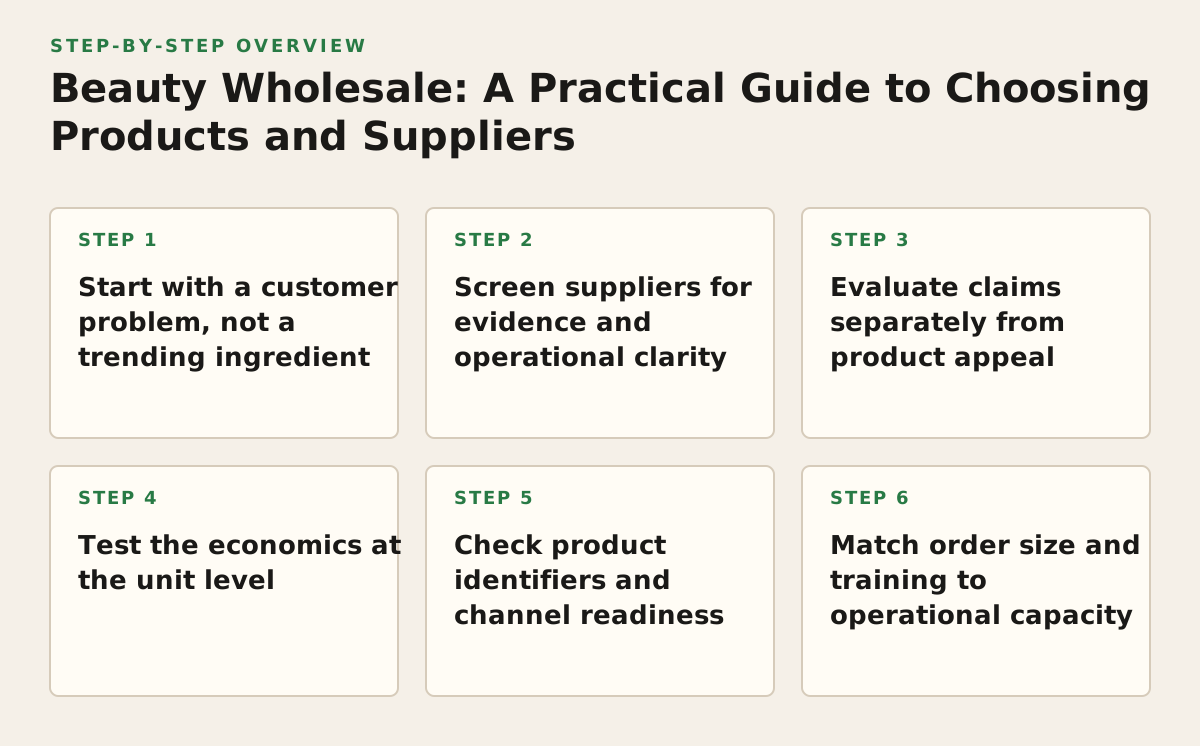
1. Start with a customer problem, not a trending ingredient
Use this principle when: a product attracts attention because of an ingredient, format, or social trend, but you have not yet established who in your customer base would buy it. A trend can prompt research; it is not a substitute for a defined customer and use case.
Why it works: a specific need gives you a basis for comparing products that otherwise sound similar. “Skincare customers” is too broad to guide a buying decision. “Existing customers who ask for a structured at-home option for targeted wrinkle care” is more useful because it suggests a shopper question, a relevant product format, and a way to test interest.
Write a buyer-use statement
Before contacting suppliers, finish this sentence: “We are considering this product for [customer] who wants [job], and will evaluate it by [observable buying signal].” The signal might be repeated requests, preorders where lawful, or a small pilot’s sell-through—not likes or general interest alone.
For a PDRN patch, for example, the customer job might be learning whether a dissolving microneedle patch fits a targeted at-home routine. That framing leads to practical questions about application instructions, ingredient information, and whether the product’s recommended protocol is easy to explain. It does not establish that the product will suit every shopper or produce a particular result.
- Name the customer: existing skincare buyer, professional evaluating a topical product, or retailer seeking a differentiated category.
- Name the use case: targeted wrinkle care, routine support, or another specific need.
- Pick a buying signal: a qualified inquiry, a purchase, or repeat demand—not an assumed conversion rate.
Failure mode: ordering because a product is popular elsewhere, without checking whether your own customers understand its use or want its format. A practical correction is to ask a small group of relevant customers what information they would need before considering it, then use those questions to shape supplier screening.
2. Screen suppliers for evidence and operational clarity
Use this principle when: comparing suppliers, or when a supplier’s pitch contains claims that are difficult to distinguish from substantiated product information. A responsive contact is helpful, but responsiveness alone does not establish product quality, compliance, or reliable supply.
Why it works: a written evidence file makes suppliers comparable and exposes gaps before a purchase. Request product and ingredient information, current product instructions, relevant claims support, and the commercial terms that apply to your intended order. Record what is confirmed, what is not, and who is responsible for answering each open question.
Use a consistent document request
- Product identity and pack or kit configuration.
- Ingredient and product information suitable for your sales channel.
- Application, storage, and care instructions, where relevant.
- Claim-support materials for statements you plan to repeat.
- Written wholesale terms, including order minimums, lead times, returns, and territory restrictions if applicable.
These are screening questions, not assumptions about what every supplier can provide. For U.S. sales, FDA explains that cosmetic labeling requirements cover matters such as identity, net quantity, ingredient declarations, and business information; check the applicable rules and product category rather than relying on a supplier’s marketing sheet alone (FDA Cosmetics Labeling Guide). The FDA’s MoCRA overview also describes changes to U.S. cosmetics regulation, so businesses should verify which responsibilities apply to their role and products (FDA overview of the Modernization of Cosmetics Regulation Act).
Failure mode: treating a missing answer as a minor paperwork delay and placing an order anyway. If you cannot verify a material detail—such as the product’s use instructions or the right to sell it in your channel—pause and ask for written clarification. If the response remains incomplete, do not build your launch plan around the unverified assumption.
3. Evaluate claims separately from product appeal
Use this principle when: a product is marketed with language about wrinkles, rejuvenation, repair, or visible results. This matters especially for skincare professionals and retailers who may repeat supplier wording in a consultation, product page, or social post.
Why it works: the strength and type of a claim affect customer expectations and may affect regulatory treatment. An ingredient name or a compelling product format does not, by itself, prove a finished product’s performance. Ask what exact statement is supported, what evidence supports it, and whether that evidence applies to the product and use described.
The U.S. Federal Trade Commission says health-related product claims must be truthful, not misleading, and supported by appropriate scientific evidence; its guidance is a useful reference when reviewing promotional statements, though rules and obligations depend on the product and context (FTC Health Products Compliance Guidance). Keep the wording you intend to use narrower than the evidence you can document. Avoid turning a supplier’s general ingredient explanation into a promise about an individual customer’s result.
Build a claim-check table
| Proposed statement | What to verify | Decision |
|---|---|---|
| Ingredient or format description | Does current product information support the wording? | Use only the verified description. |
| Application or routine instruction | Does the product’s official guidance specify this use? | Repeat the instruction accurately. |
| Outcome or efficacy statement | Does product-specific evidence support the exact claim? | Omit or revise if support is missing. |
For instance, a retailer considering a PDRN microneedle patch can explain the product format and direct a shopper to the supplied application guidance, while avoiding a guaranteed wrinkle outcome. Cleanical Lab shares product and efficacy information for its Salmon PDRN patch system; review the scope and wording on its Salmon PDRN patch efficacy page before deciding what, if anything, is appropriate to communicate.
Failure mode: copying the strongest claim from a supplier’s social post into your own product listing without checking its basis or context. Maintain a claims file with the exact approved wording, the supporting document, and the channels where the wording will appear. If that support is unavailable, describe the product rather than promising an effect.
4. Test the economics at the unit level
Use this principle when: a product seems commercially attractive but the quoted wholesale cost is only one part of what it takes to sell. A low unit cost does not ensure a viable offer if shipping, payment fees, sampling, fulfillment, or likely markdowns erase the margin.
Why it works: calculating a contribution estimate before placing an order shows which unknowns matter. Start with the supplier’s written quote and your actual channel costs; do not substitute an online retail price or an assumed discount for a confirmed wholesale term.
Use a simple cost worksheet
- Expected selling price, based on your channel and customer research.
- Quoted product cost per sellable unit.
- Inbound freight, duties, or other costs that apply to your shipment.
- Packaging, fulfillment, payment, and sampling costs attributable to each sale.
- Potential returns, damage, or markdown allowance, using your own policy or past records.
Subtract the per-unit costs from the expected selling price to estimate contribution before overhead. Then stress-test the estimate: what changes if your actual selling price is lower, freight is higher, or some stock remains unsold? The purpose is not to predict the future precisely; it is to expose whether the decision depends on optimistic assumptions.
Failure mode: treating gross margin as cash profit or using a retail price that no customer research supports. For an illustrative exercise, compare a conservative, expected, and optimistic selling-price assumption in the same worksheet. Label the assumptions, then replace them with supplier quotes and channel data as they become available.
5. Check product identifiers and channel readiness
Use this principle when: a product will be listed online, sold through a marketplace, managed across multiple stock locations, or distributed to other retailers. The more places a product moves, the more costly it becomes to reconcile inconsistent names, pack sizes, and identifiers.
Why it works: a consistent product record reduces listing and inventory errors. Confirm the exact sellable unit, variant, kit contents, and identifier with the supplier. Do not assume a single-treatment pack and a multi-treatment kit are interchangeable records just because they share a product name.
GS1 describes the GTIN as an identifier for trade items; confirm with the supplier which identifier belongs to the specific item or pack you intend to sell, and follow the requirements of your own sales channel (GS1 overview of GTINs). For U.S. marketplace listings, Google Merchant Center’s product data specification shows that product feeds have defined data fields and requirements, making it useful to check listing readiness before preparing a catalog (Google Merchant Center product data specification).
Make one master product record
Keep the supplier’s product name, your internal SKU, pack configuration, identifier, approved description, images or assets you have permission to use, and reorder contact in one controlled record. For a kit, document the number of treatments and included items as confirmed—not as inferred from a product family name.
Failure mode: creating a listing from an outdated or incomplete product sheet and discovering later that the pack configuration differs. Before publishing, compare the record against the actual supplier documentation and the item being offered. If identifiers or pack details are unavailable, ask before creating a live listing.
6. Match order size and training to operational capacity
Use this principle when: an item needs explanation, has a multi-step use protocol, or is unfamiliar to your staff. A product can be suitable for a niche customer but still be a poor launch choice if your team cannot answer basic questions or manage stock responsibly.
Why it works: a smaller, controlled launch limits exposure while revealing the practical questions customers ask. Decide the order size only after the supplier confirms available configurations and terms. Consider how quickly you can train staff, explain product use, and handle a customer who needs clarification.
For a topical product, training should cover the verified application instructions, ingredient information, claim boundaries, and when staff should refer a customer to the product’s official guidance rather than improvising. Cleanical Lab sells Salmon PDRN dissolving microneedle patches in one-, five-, and ten-treatment kits and provides a 72-hour application schedule for a five-application protocol. A retailer should still confirm the specific wholesale terms, stock, and suitability for its channel directly rather than infer them from the consumer-facing kit options.
Failure mode: ordering a larger quantity to obtain a presumed discount before understanding sell-through, storage, or staff readiness. A better starting policy is to choose the smallest order that lets you evaluate customer questions and operational fit, if the supplier’s confirmed terms permit it. This is a decision rule, not a universal order-size benchmark.
7. Turn the evaluation into a sequenced launch decision
Use the following sequence to keep research from becoming an open-ended exercise. Each gate should produce a record or decision; unresolved questions should remain visible instead of quietly becoming assumptions.
- Define the customer and job. Write a short buyer-use statement and identify the evidence that would indicate meaningful interest.
- Shortlist products. Compare options against the same need, format, documentation, and channel fit rather than choosing by ingredient trend alone.
- Request supplier evidence. Collect current product information, instructions, claim support, identifiers, and written commercial terms. Mark every unanswered item.
- Review claims and obligations. Check the wording you plan to use against available evidence and the rules for the markets where you will sell. Seek qualified regulatory advice when the classification or responsibility is unclear.
- Model unit economics. Use confirmed cost inputs where available and label estimates. Reject a plan that works only under an unsupported price or sales assumption.
- Prepare operations. Create the product record, train staff on verified information, and set a reorder or stop-review point based on your own sales and cash constraints.
- Launch narrowly and review. Track customer questions, purchases, returns, and stock movement. Continue, adjust, or stop based on observed results rather than a supplier’s general market narrative.
This sequence is useful whether you are evaluating a new wrinkle-care item for a skincare practice or sourcing a broader beauty assortment for resale. Cleanical Lab is a relevant candidate only if your customers are interested in its Salmon PDRN dissolving microneedle patch system and the product fits your evidence and operating checks. For confirmed commercial terms, use Cleanical Lab wholesale inquiries; the inquiry route does not itself establish pricing, minimum order, availability, or territory.
If targeted at-home wrinkle care is part of your assortment, you can review Cleanical Lab’s Salmon PDRN patch system and product guidance before deciding whether to ask about wholesale terms.